Sunday, 8 April 2012

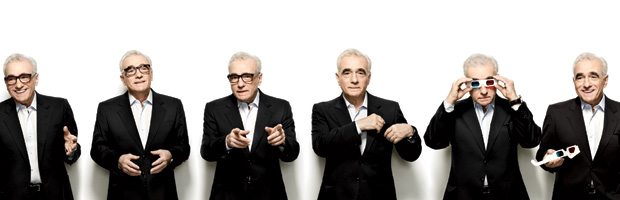
Some know him as God, You may call him Marty


In a world where the superstars or actors pull-in the crowd, how many directors manage to do the same?  How many directors command a bigger pedestal than the cast of the movie? Not many, I guess.

During the Academy awards, one name was invoked more often than anybody else’s name. Martin Scorsese.
After giving us 22 movies, 13 documentaries, many commercials and  just 1 Oscar, the 70 year old Marty, as he is fondly called, gave us HUGO.
Whether it is gritty and violent like MEAN STREETS, TAXI DRIVER or poignantly romantic like ALICE DOESN’T LIVE HERE ANYMORE, or satirical like THE KING OF COMEDY, AFTER HOURS or just plain stylish like AVIATOR, GOODFELLAS, Marty‘s uniquely versatile vision has made him one of cinema’s most acclaimed directors.

As a young kid, bought up in the little Italy section of Manhattan, he decided to “Make movies about what really happens”. In hindsight, you will know that Marty does not only make movies, but also is a great movie fan with a insatiable appetite to watch, discuss and enjoy cinema. His inspiration for making movies can from came from his own childhood spent in the Bronx. By his own admission, he said that the biggest research he did for making Mean Streets, his first major release, was his life. He would watch people in the gritty neighborhood go about their life and business and just poured his experiences in the movies that have made him the man he is today.

40 years after he made his first major Hollywood movie, his balance sheet looks balanced. He is one of the few directors today who have received both critical and box office acclaim. Of course, like anybody, he did go through a lean patch in the late 70s and early 80s when none of the studios supported him after box office disasters like New York, New York and The King of comedy. His professional life dipped further when studios did not accept The last temptation of Christ, as it was deemed too radical.  All the while, he lived in Los Angeles, he learnt the mechanics of how large cities function. It was this knowledge that he put to use to bounce back. He moved back to New York to set his professional career on track.

The second part of his career is the part where-in he came into his own. He belted out movies like The last temptation of the Christ (he made Universal studios to produce the movie), Raging Bull, Goodfellas, Cape Fear, Casino and Kundan before ending the millennium on a high. Post 2000, having juiced DeNiro with some fine performances his association with Leonardo Dicaprio began. The noughties saw Scorsese shed his Mafia fixation and dabble into big budget set piece movies. Scorsese and Dicaprio would collaborate to give us movies like Gangs of New York (a script that he had been wanting to make for 20 years, with DeNiro in the lead), Aviator, Departed (the movie that won him the most coveted Oscar, finally), and finally Shutter Island.


While all of us love the overall feel of his films, he should be credited for all the factors and innovations that he bought to cinema.
 Known as the “king of tracking shot”, he is known for his lengthy takes. Most of his movies start and end with 2-3 minute scenes, which is a mean feet.  Other contributions like bring the “New York vernacular” talk in movies like Mean Street, Goodfellas, color treatment in movies like Aviator, Gangs of New York, and now re-interpretation of how 3D can bolster a film’s beauty without intruding on the story  only add to his folklore.
Having been fed on movies by Howard Hawks, Billy Wilder, Sidney Lumet, he was adamant about learning from them and developing his own unique style of film making. He was mainly influenced by these greats, because, they did not bend down in front of the Hollywood studio system and got their creative vision on screen.

When not giving in to the big studios or simply battling it out with them, he vented out his creative genius into making documentaries , music videos (the Rolling Stones concert and Micheal Jackson shows were legendry)  and restoration of old-movies.

His style of movie-making combined a rough and gritty attention to the everyday life of the urban jungle with a monumental visual sensibility. In one of his most acclaimed films, Taxi Driver 91976), he focused on the particulars of an individual and his obsessions. Starring Robert DeNiro (with whom Scorsese has had one of the most celebrated collaborative relationships in American cinema), Taxi Driver elevates the obscure specifics of a disturbed life with greatest drama.
Through movies like Mean Streets, Goodfellas, Casino, Departed, he has shown us the engaging world and power structure of Mafia. He bought together and style and theoretical content with great flair. Scorsese often focused on a theme that has permeated nearly everyone of his movies – the plight of the desperate and out-of-control individual. Often unsympathetic, his characters display a crazed violence that mimics the repressive social structures in which they live. Almost all his movies are engaging and social commentaries.

Martin Scorsese is the most important living American filmmaker – one whose relentless search for the furthest emotional reaches of his genre have led him to the center of the American ( and global) psyche.
In an era where careers are measured in months rather than years, Marty has served us for close to 45 years. In Hollywood, that is no lesser than a battlefield, he has battled it out with studios, stars and himself.
But all this has not resulted in a burn-out. At the age of 68, he set out to make a 3D movie. For a man who has always believed in old-school film making, and who has never tasted massive box office success (his most successful film was Shutter Island, that grossed $ 300 million worldwide), he adapted to the rigors of a new technique of film making. He has achieved three things that very, very few filmmakers achieve in life – (1) Enough money to make movies and documentaries that interest him, (2) enough freedom to make the movies in the way he wants to make them, (3) Enough acclaim and appreciation (not in the way of awards , though) from his peers and fans.
His lack of recognition from the Academy awards actually adds to rather than detracts from his reputation: after all, Orson Welles, Alfred Hitchcock and Stanley Cubrick were also all denied Oscars.

Just like a 3 minute show reel of a lifetime’s work cannot do justice to a man or his body of work, this is just a sincerely written piece of tribute to a man who has worked his lifetime to entertain us. I raise a toast to Marty, the movie fan, who also makes movies. 


( This post was first published on www.madaboutmoviez.com - http://tinyurl.com/brhcxov )

Tuesday, 27 March 2012

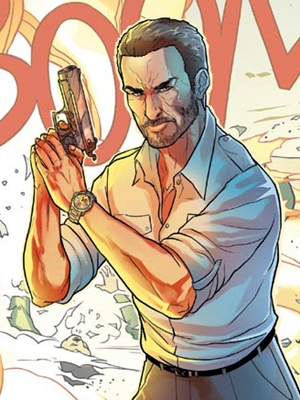
Why do I prefer Agent Bob Biswas over Agent Vinod?

With the Hindi film industry churning out over 800 films each year, films that really matter are few and far between. Yet, I find myself seated in the nearest multiplex, every weekend to catch the latest motion picture.
This year has been fascinating. Without getting ahead of myself, I would say that most of the movies have been worth the ticket, pop-corn and petrol.
Then came Agent Vinod!!!


My expectation soared when I heard that Mr. Shriram Raghavan was at the helm of things. In our country obsessed with STARS (not actors), how many would go to watch a movie because of the director, and not because of the star? Afterall, how could a guy, who gave us gems like Ek Hasina Thi & Johnny Gaddar go horribily wrong, you may ask? Well, he did go wrong. So badly, that he lost a fan in me. I'm not ready to give him a second chance, just yet.


The movie was not THAT bad, but I do not buy the "Production valueas were superb" line anymore. Thanks to production houses like Excel Entertainment, Dharma productions, most movies are well shot, superbly produced.


Now, why dont I like our own James Bond? Surely, the movie screams style. That is it. It is like one of those glossy expensive men's magazine (No, I'm not talking about GQ) that have loads of pics, but suck when it comes to content. What makes you averse of the wannabe, super / hyperstylised superhero is that, within a span of a month we have seen two more superheros who are original, non-wannabe, completely desi and loads of charecter. I'am talking about Irfan Khan in Paan Singh Tomar and Vidya Balan in Kahani. These two gave us a temporary sense of happiness and made us believe & hope that all is not last.
This post is not about story of Paan Singh Tomar or Kahani or Vidya Balan though. Enough said and discussed about it!!


This is about Agent Vinod pitted against Agent Bob Biswas and Mr Tomar.  

An LIC agent outshot and a Chambal decoit has outrun the smart,sauve RAW agent. 
The popularity of Bob Biswas and Pan Singh over Vinod throws up a few points.


1) You do not have be dressed in tuxedos to impress the audience.


2) You do not have to be a globe trotter. (A friend of mine posted this on Facebook - Considering the movie covers 8 locations and our does not do much any way, the movie should have been called TRAVEL AGENT VINOD.) While Agent Vinod goes out and apes James Bond and Bourne films, Bob & Pan Singh just do the opposite.

3) You do not need angrezi with accent. Irfan spoke so convincingly in HIndi with the chambal accent that forced us to rely on subtitles and Bob Biswas did it with a simple "Nomoshkar...ek minute"...


4) You do not need to be in every scene of the movie to get noticed - OK this one does not apply for Mr. Paan Singh. But, Bob Biswas, with barely 10 minutes of screen presence, has become a household name and a social media rage.


5) You do not have to dance to  silly and stupid item numers like Pungi, just incase, the audience does not like you in the first place.


6) You do not need silly mannerisms, punch dialogues and a swagger to get the audience hooked. Again, just a simple Namoshkar works...


While, I have already undermined Agent Vinod, I would say it was entertaining in parts at best. Cannot take away the sheer gineus of a way in which Shriram has shot the RAABTA song. Splendid. Cannot take away the "always on it's toes" background score. Cannot take away the frentic camera work. But that is it. Game over. It is not Max Payne. It is a movie.


What makes us fall for Bob & Paan Singh? Well, in Bob's case, it was simple. While, we are use to see burly, tough men play out the charecter of a hitman, Bob surprised us with his commonman and unasumming looks. He could be the most unlikely guy to play a hitman. Yet, he doid it with elan. And Pan Singh? Hehe, It was Irfan Khan. Enough said.


Now, it is not Saif's mistake that he is being pitted against these splendid guys. Just that , we expected better.


I guess, I will just have to accept Agent Vinod as a film that belongs to Saif the producer, than a film that belong to Shriram, the director.
Last heard, they are planning to make a sequel. 

Let's hope, sense prevails and we get to watch and cheer a truly well etched, detailed, desi, non-wannabe spy movie.

Thursday, 15 March 2012

Kahani - A story we want to believe in


By the time you read this, I’m sure you would have seen Kahani. Some of you would have seen it twice, maybe.
I can safely say that sensible cinema makes a comeback to the Hindi film industry.

Seldom do we, the people in the Hindi film industry tell stories of our cities. Forget telling stories about them, we do not even use them as good backdrops. Once in a while we may see Dibakar Banerjee use Delhi as a splendid backdrop (Khosla ka Ghosla and Oye lucky lucky oye) to tell his stories or Kiran Rao shoot Mumbai in such a way that it re-introduces us to the city we live in.
Kahani opens with a shot of Kolkata, and you immediately you warm up to the prospect of something different and new. Sujoy makes passionate love with Kolkata the way we have seen Woody Allen make love to Manhattan or Paris through his films. Mind you, this is not a stupid placement or government funded / aided tour, but pure, unadulterated love for the city. What you see in Kahani is nothing short of a treat.The lazy trams, the cramped alleys, the crowded markets, Durga Pujo is shot with splendid detail and care.
Sujoy lets his cinematographer, Setu, bite into Kolkata and give us a heady cocktail of cacophonous city. The dust, grime, color and the air of the city come alive in each frame of the movie.


The second lead of the film (Kolkata is the lead character) Vidya Balan is just as outstanding as the city itself. She is one women whose body of work might one day end up mirroring that of Meryl Streep. It is getting REALLY difficult choose the best amongst her performances. Vidya’s performance as a heavily pregnant woman is so damn convincing that just 10 minutes into the movie, you are rooting for her and you let her enthrall you. She gets you to do what most superstars (I’m not saying actors) do not. She gets you to root for her, go through  the roller coaster ride with her instead of just sit and watch her go through her lines. Your feelings / emotions for Vidya Bagchi only gets more sensitive as the movie progresses.

It has been a week since I saw the movie and I have probably read zillions of tweets and Facebook updates that spoke about how Vidya Balan has rocked the show. Agree. No two ways about it. But, spare a thought for the guy who made this whole movie possible, the guy who conceived this movie, and left no stone unturned to get this movie to screen.
(Pls go through the link at the end of this post. Once you are done reading the whole post, that is).

While most us know that he is more than a capable director, what clicks for him in Kahani is his writing. This movie does come across as his most passionate, most loved and most cherished work. This is one of the most smartly written work in the recent past. First of all, kudos to him for resting a very tricky genre on the shoulder of a woman, a pregnant one, no less.
The movie is like a puzzle where-in the viewer does not watch characters unfold the twists and turns. Here Sujoy sucks you into the vortex immediately. The viewer is taken trough a highly fulfilling roller coaster ride. It has all the elements of a classic whodunit. The story grabs your attention almost immediately, keeps you enthralled, teases you along the way, makes you hold on to your breath, throws little tit-bits at you and in the end gives you the high of a 12 year old seasoned scotch whisky. This is beautiful blend of Hitchcock and Satyajit Ray in equal measure.

While it would be criminal to give away any of the plot details it would be in the scope of permissible praise to say the writing is clearly not meant to strew red herrings in our way. As we go back to the film, at the end we see every detail, every twist and turn in the plot was meant to be a coherent pointer to the complete picture 
Though, it feels longer than 115 minutes, there is never a dull moment, as every character keeps throwing something at you to keep you guessing, wanting you to crack the code.
The experience is heightened by some razor sharp editing and a rousing background score by Clinton Cerejo. In fact, the score is largely responsible for the tight pace of the movie.

At the end of it all, you come away as a happy person, because, here is a movie, that satisfies the thirst for good cinema. It makes you believe that Hindi movies can indeed entertain and rewarding.  

As promised, here is a link to Sujoy Gosh’s blog on Kahani :


See you at the movie :)